
Will 3D Maps Solve The Mystery Of My Painting?
Blog|12 December 2017
The Lustleigh Cleave is a deep valley on Dartmoor through which the River Bovey flows. It’s not far from the Grey Matter offices in Ashburton. I live on the edge of the Cleave which is now heavily wooded and designated a Site of Special Scientific Interest (SSSI) on account of the habitat which is home to numerous rare species of plant and wildlife. But it was not always so. Photographs, and before that etchings and paintings, show it to have been heavily grazed. It was an open space in the first half of the previous century and certainly the one before that.
The history of the Cleave fascinates me and I’ve been collecting images to build a picture of it’s past. A few years ago, I acquired a rather grand Victorian oil painting which was painted somewhere in the valley and I’d love to identify the scene it portrays. The pile of rocks and upstream waterfalls should make identification easy but so much of the Cleave is now almost impenetrable with bracken and brambles, and the skyline is mostly obscured by tall trees. The military occasionally fly through the valley on (terrifyingly) low flying exercises and could probably offer some insight from their visual vantage point but I’d rather they concentrated on the job of not hitting something rather than try to solve the mystery of my painting. I’ve often wondered whether mapping technology could come to my aid one day and allow me to traverse the area in 3D, suspended above the treetops in a safer and more leisurely manner so that I could identify the skyline corresponding to the one in the picture.
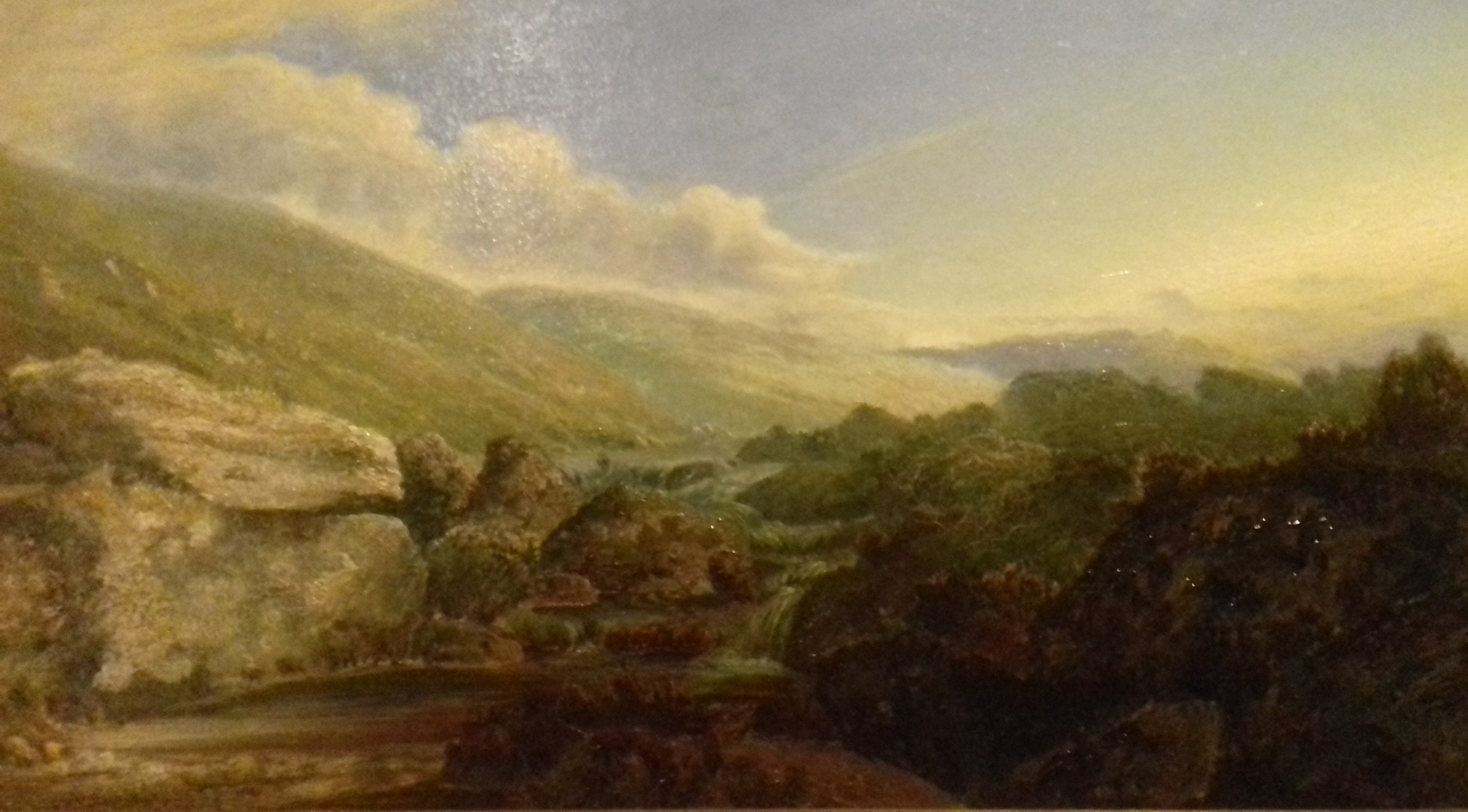
Above: The 19th century painting of the Lustleigh Cleave.
The images that 3D maps depend on are becoming more widely available and the Prague-based start-up Melown Technologies is doing some incredible things with a combination of image material and the technology they’re developing for it. We can forget the Lustleigh Cleave for a moment. Having been introduced to their website, I was quickly distracted by the prospect of being able to fly across the globe and drop into any city that took my fancy, from Athens to London where I was able take myself for a quick tour of the gardens at Buck P! If garden parties aren’t your thing, you can take yourself off for a quick scoot around the craters and valleys of Mars, or Mercury for that matter!
Here’s a link to the Melown web site that will allow you to explore almost anywhere on the planet. Hit the zoom-out control a few times, spin the globe and take yourself off to a city of your choice.
https://www.melown.com/cloud/link/rhuIZRhFKlk4udMEHF9G
If Mars is more your thing, head across to:
For a deeper exploration of the solar system, take a flight with:
https://www.google.com/maps/@0,-3.7553851,22963938m/data=!3m1!1e3
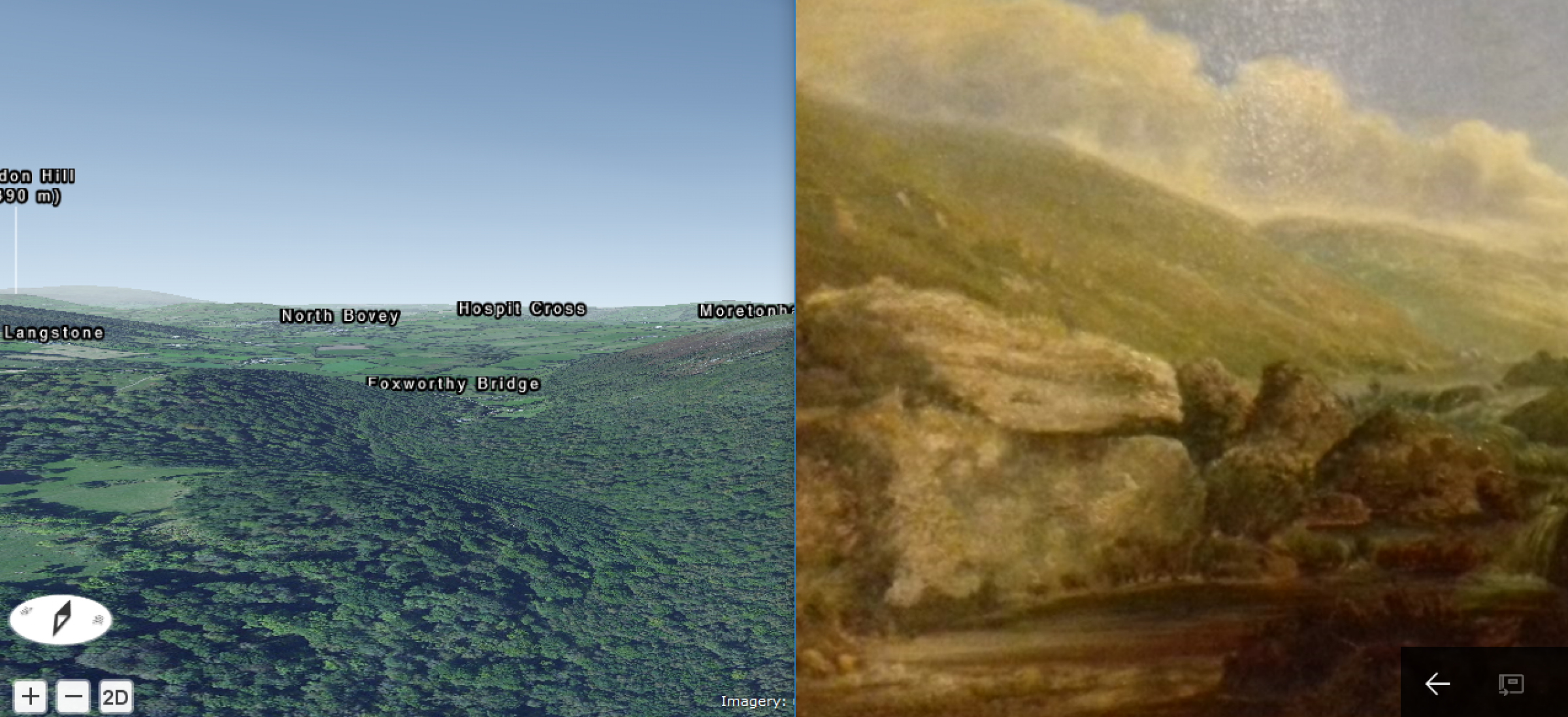
Returning to my picture, I used Melown’s web site to explore the Lustleigh Cleave, as illustrated below. This illustrates the challenge in so much as the river runs deep in the wooded valley and from that perspective, the skyline in the painting probably represents features much closer than the distant hills in the satellite image even though there are similarities. In this case, existing satellite imagery is probably insufficient. The Dartmoor National Park and various other agencies that monitor the habitat may well have images from drone missions and if so, a more detailed 3D analysis might be possible at some point.
Above: A 3D view of the Lustleigh Cleave captured using Melown’s VTS map technology.
In all probability, my painting will remain something of an enigma and one I may never solve. Another painting of a familiar and unaltered Dartmoor scene by the same artist came to my attention recently. Unfortunately, the painting bears little resemblance to reality which suggests the artist concerned, though clearly very gifted, exercised a fair amount of artistic license! The tech world we live in today with its 3D mapping capabilities would have been far beyond anything he could have imagined some 120 years ago when he painted on the banks of the Bovey.
Over the next few months, I’ll be looking at various use cases for mapping technology and some of the amazing things being done with it. I’ve asked the team at Melown to enlighten us about their technologies and at the same time, Code Matters will be getting down to the coding and practical issues of developing with maps and location data. As many of our developers work with the Microsoft stack, we will be focusing quite heavily on Bing Maps.
In case you’re wondering (and you probably aren’t!), Bovey is pronounced ‘Buvvy’ in this neck of the woods!